FRANÇOIS DEVIENNE – Sonata in E Minor, Op. 58 No. 1 (1771)
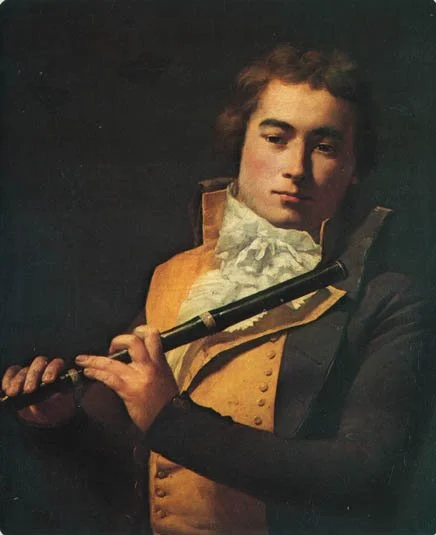
Devienne was an accomplished flutist, bassoonist, and composer who enjoyed an active performing career as both a soloist and orchestral musician. A leading flute professional of his time, he was one of the first flute professors appointed at the Paris Conservatoire. Devienne strongly favoured the one-key flute, a historical instrument notorious for its intonation problems and awkward fingerings. He was also critical of the then-emerging techniques of double- and triple-tonguing in fast passages.
As both composer and pedagogue, Devienne played an important role in elevating the artistic standard of wind music in late eighteenth-century France. He composed over 500 works, contributing significantly to the concerto, the sinfonie concertante, and the opera. His compositional style is generally conservative, characterised by graceful melodic writing supported by transparent accompaniment textures. His instrumental works, as seen in Sonata in E Minor, Op. 58 No. 1, are often interspersed with sections written to display the performer’s virtuosity. Although Devienne’s music remains comparatively little known today, even among flutists and bassoonists, his influence endures through his celebrated method book for the one-key flute, Nouvelle méthode théorique et pratique pour la flûte (1794), which addresses flute technique, articulation, and late eighteenth-century performance practice.
Dedicated to Devienne’s close friend and fellow flutist Antoine Hugot, the six sonatas of Op. 58 are fundamentally rooted in the galant style. Sonata in E Minor displays many of the style’s characteristic features, including graceful melodic lines, homophonic textures, elegant phrasing, and clear structure. The use of E minor, however, adds emotional seriousness and expressive tension to the music, evoking Sturm und Drang aesthetic. The energetic passages, the wide leaps in the flute part, and syncopated rhythms infuse the sonata with agitation and urgency, revealing how Devienne balances galant elegance with a more impassioned expressive language.